Switzerland records a fall in net immigration: the labour market remains the main magnet for foreign professionals
Switzerland recorded a fall in net immigration in the first half of 2026, while the labour market remains the main magnet for foreign professionals.
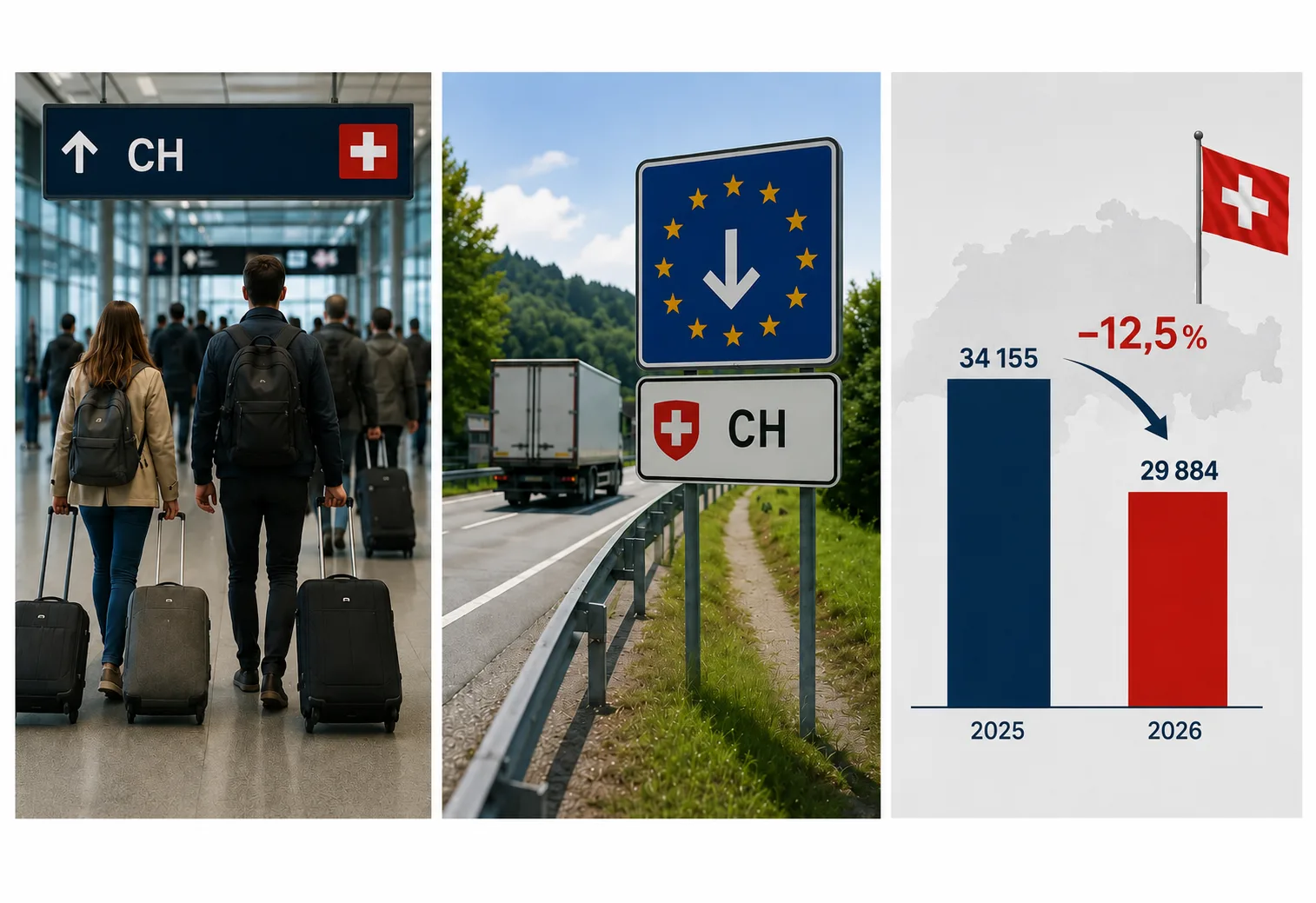
In the first half of 2026, Switzerland recorded a continued decline in net immigration, while official data at the same time show that the labour market remains one of the key reasons why foreign professionals and workers choose this country. The latest figures provide a broader picture of changes in one of Europe’s most attractive labour markets.
According to data from the Swiss State Secretariat for Migration, SEM, net immigration of the permanent foreign resident population fell by 12.5 percent in the first six months of 2026 compared with the same period of the previous year and amounted to 29,884 people. This is a continuation of the trend recorded by the Swiss authorities in recent years, with a simultaneous decrease in arrivals and an increase in the number of people leaving the country.
The official release and complete data were published by the Swiss Federal Administration and the State Secretariat for Migration (SEM). Official SEM report.
Fewer arrivals, more departures
From January to the end of June 2026, a total of 74,112 people immigrated into Switzerland’s permanent foreign resident population. That was 2,220 fewer people than in the same period of 2025, a decline of 2.9 percent.
At the same time, 39,251 people left Switzerland, an increase of 1,608 people compared with the first half of the previous year. It was precisely the combination of fewer new arrivals and more departures that led to a more pronounced fall in net migration.
The change is particularly visible among nationals of countries outside the European Union and EFTA area. In the first six months of 2026, 18,351 people immigrated from those countries, nine percent fewer than a year earlier.
In the same period, 55,761 people arrived in Switzerland from EU and EFTA countries. In this group, the decline was considerably milder, at 0.7 percent.
At the end of June 2026, Switzerland was home to 2,432,444
foreign nationals.
The labour market remains at the centre of migration flows
For international professionals, perhaps the most important fact is that the decline in overall net immigration has not changed the fundamental reason why a large number of people come to Switzerland.
It is work.
According to SEM, the labour market continues to be the most important factor in Switzerland’s attractiveness as a country of immigration. As many as 80.5 percent of immigrants from the EU and EFTA who arrive within the framework of short-term or long-term employment are connected with work in Switzerland.
By the end of June 2026, 41,321 workers from EU and EFTA countries had immigrated to take up long-term employment. Compared with the same period of the previous year, their number fell by 679 people, or 1.6 percent.
A further 36,367 people from EU and EFTA countries came for employment lasting less than one year. This category also recorded a slight decline of 1.8 percent.
The broader picture of the Swiss labour market, however, shows that foreign workers continue to play an exceptionally important role in the country’s economy. According to the Federal Statistical Office, approximately 1.87 million foreign nationals were working in Switzerland in the first quarter of 2026, and 78.8 percent of them came from EU and EFTA countries.
Official statistics on the participation of foreign workers in the labour market are available from the Swiss Federal Statistical Office (FSO).
Changes are also visible among cross-border workers
Switzerland’s migration picture does not end with people who move permanently to the country. A large part of its labour market has traditionally also consisted of employees who live in neighbouring countries and work in Switzerland every day or on a regular basis.
In the first half of 2026, 33,219 new permits were issued to cross-border workers. A year earlier, there had been 36,876.
At the same time, the number of registered short-term stays increased. In the first six months of 2026, 169,514 were registered, compared with 164,779 in the same period of 2025. Around 60 percent of those registrations concerned people who entered into short-term employment with a Swiss employer.
What the new data mean for international candidates
The fall in net immigration does not in itself mean that Switzerland has stopped attracting international labour. The official data instead point to a change in the intensity of migration flows.
The Swiss economy had approximately 5.35 million employed people in the first quarter of 2026, 0.2 percent more than a year earlier. At the same time, the number of employed Swiss nationals was slightly lower, while the number of employed foreign nationals recorded growth.
FSO: employment in the first quarter of 2026. FSO: foreign labour force. For international candidates, it is therefore important to distinguish between two phenomena. One is overall migration statistics, which show how many people enter and leave the country. The other is labour-market demand, which determines where and under what conditions opportunities exist for the employment of foreign professionals.
The latest SEM data make this distinction particularly visible. Net immigration is lower, but work remains the central reason for the arrival of a large part of the foreign population.
For the GlobalTalent24, a platform that follows international recruitment, professional mobility and access to foreign labour markets, this change is an important signal. The Swiss labour market is entering a period in which arrivals are no longer increasing at the pace seen in previous years, but its dependence on international labour remains clearly present in the official statistics.
In other words, the story of Switzerland in 2026 is not only a story of lower immigration. It is the story of a labour market that continues to attract large numbers of people from beyond its borders, while the structure and dynamics of that mobility gradually change.
Sources: Swiss State Secretariat for Migration, official data for the first half of 2026, and the Swiss Federal Statistical Office, data on the foreign labour force.