Europe Needs Workers. For Latin Americans, the Question Is No Longer Whether Opportunities Exist, but How to Access Them Legally
Europe’s labor shortages are creating new opportunities for Latin American professionals and workers. The key is understanding where skills are in demand and how to access employment legally.

From Madrid and Vienna to Berlin and Zurich, Europe’s labor market is undergoing a transformation that is creating new opportunities for professionals and workers from Latin America. The demand for talent is real, but between the ambition to build a life in Europe and the reality of legal employment lies one decisive factor: access to the right information.
Europe has been talking about labor shortages for years. An aging population, fewer young people entering the workforce and growing demand across key industries are putting increasing pressure on companies to look for talent beyond their traditional borders.
For millions of people across Latin America, this represents an opportunity that only a few years ago seemed far more difficult to access.
Spain is a natural first destination for many Latin Americans because of language, culture and historical ties. Germany has developed one of Europe’s most ambitious frameworks for attracting international workers. Austria continues to seek qualified professionals across a range of sectors, while Switzerland, although not a member of the European Union and considerably more restrictive for citizens from outside the EU and EFTA, remains one of the continent’s most attractive labor markets because of its salaries, stability and strong economy.
But the European opportunity comes with an important warning.
Wanting to work in Europe is not the same as having the legal right to work in Europe.
That is the distinction every candidate needs to understand before buying a plane ticket.
The New European Dream Starts Before the Airport
One of the biggest mistakes international candidates can make is treating relocation as a journey rather than as a professional project.
Legal employment migration begins long before departure. It starts with understanding the labor market, identifying the right country, researching the legal requirements, preparing a competitive professional profile, finding an employer or an appropriate immigration pathway and gathering the necessary documentation.
Every European country has its own rules. What works in Spain may not work in Germany. Austria’s system is different from Germany’s, while Switzerland operates under a very different framework when it comes to candidates who are not citizens of EU or EFTA countries.
That is why the question candidates often ask, “How can I move to Europe and work there?” is actually too broad.
The better question is: In which country do my education, professional experience, occupation and language skills have the greatest market value, and which legal pathway could allow me to work there?
That change in perspective can save months of unsuccessful applications, unnecessary expenses and frustration.
Employers See the Candidate Before They See the Passport
There is another major shift that international candidates often underestimate.
Digital recruitment has dramatically reduced the geographical distance between companies and talent.
In the past, a professional from Colombia, Argentina, Mexico or Peru looking for a job in Europe faced an obvious disadvantage. The candidate could be thousands of kilometers away from the company they wanted to approach.
Today, the first interview can take place from Bogotá, Medellín, Buenos Aires or Mexico City while the employer sits in Madrid, Munich, Vienna or Zurich.
Geography is no longer always the first obstacle.
Visibility is.
A candidate may have ten years of experience, excellent results and valuable professional skills. But if their CV does not communicate that value in a way a European employer can quickly understand, much of that advantage disappears.
A CV is no longer simply an administrative document. It is a professional presentation of value.
The same applies to a cover letter. It should not be a generic text sent to dozens of companies. It should explain why the candidate fits a specific role, what they can contribute and why that particular professional opportunity makes sense.
There is also a third format becoming increasingly relevant for international candidates: video.
A short professional video presentation gives an employer something a traditional document cannot. It allows them to see the person behind the application. Communication skills, confidence, language ability, personality and the capacity to present oneself professionally can sometimes communicate more than another page on a résumé.
For a Latin American candidate applying from thousands of kilometers away, that can become a meaningful competitive advantage.
Europe’s Problem Is Not Only a Shortage of People. It Is Connecting the Right People With the Right Companies
On one side of the Atlantic are people looking for better professional opportunities.
On the other are companies struggling to find enough qualified candidates.
Between them sits a significant information gap.
This is precisely where a new generation of employment platforms is beginning to emerge, combining services that candidates previously had to find across numerous websites and disconnected sources.
One of these projects is GlobalTalent24, a platform designed as a digital connection point between international candidates and the European labor market.
The idea goes beyond simply allowing someone to search for a vacancy.
Job boards already exist.
The bigger challenge is helping candidates become ready for the European market.
Through GlobalTalent24, candidates can search for employment opportunities, create professional CVs and cover letters, and introduce themselves to companies through video presentations. The platform’s Magazine also focuses on the practical side of building an international career, providing information about labor markets, relocation and legal routes to employment in countries including Spain, Germany, Austria and Switzerland.
That distinction matters.
Someone planning an international career does not only need a job advertisement.
They need a map.

Spain Could Be a Natural Gateway for Latin American Talent
If there is one European country with a unique position in relation to Latin America, it is Spain.
A shared language removes one of the largest barriers to international employment for millions of candidates. Cultural familiarity can make integration easier, while certain legal provisions may also be particularly relevant to citizens of some Latin American countries over the longer term.
But a common language is not a substitute for legal procedure.
Candidates still need to understand the basis on which they may legally live and work in Spain, which documents are required, whether professional qualifications need to be recognized and which obligations must be fulfilled with the relevant authorities.
Spain may feel familiar.
Its bureaucracy will not necessarily feel familiar to someone who has never navigated it.
Germany Is Playing a Bigger Game for Global Talent
Germany faces a different challenge.
Europe’s largest economy needs people.
Demographic change and labor market pressures have pushed the country to rethink how it attracts qualified workers from outside the European Union.
For Latin American professionals, that matters.
But opportunity should never be confused with automatic eligibility.
Education, professional experience, recognition of qualifications where required, language skills, occupation, employment offers and the specific legal pathway can all play a decisive role.
In other words, Germany may be increasingly interested in international talent, but candidates still need to understand the system they are trying to enter.
Those who begin preparing before applying for jobs will have an advantage over those who start researching the legal process only after an employer responds.
Austria Rewards Qualifications, but Preparation Matters
Austria often receives less attention than Germany in conversations about international employment, yet it can represent a highly interesting market for certain professional profiles.
Qualifications, work experience, occupation, language ability and a concrete employment opportunity can all influence a candidate’s prospects.
For a Latin American considering Austria, sending applications randomly is unlikely to be an effective strategy.
Candidates need to understand where genuine demand exists, what Austrian employers expect and whether their professional profile corresponds with a realistic pathway to legal residence and employment.
In international recruitment, one hundred poorly targeted applications can be worth less than ten carefully prepared ones.
Switzerland Is Attractive, but the Rules Are Different
High salaries, quality of life and the presence of global companies make Switzerland one of the world’s most desirable professional destinations.
It is also a market where candidates need to be particularly realistic.
Switzerland is not a member of the European Union, and access to its labor market can be considerably more demanding for nationals of third countries. For many candidates, simply finding a company willing to hire them may not be enough.
Switzerland should therefore not be presented as an easy route into a European career.
For certain highly qualified professionals, it can offer extraordinary opportunities. For other candidates, Spain, Germany or Austria may represent a more realistic starting point.
A smart international career does not necessarily begin by choosing the country with the highest salary.
It begins by identifying the country where a candidate has the strongest combination of market demand and a realistic legal pathway to employment.
The Most Expensive Mistake Is Trusting the Wrong Person
Wherever there is strong demand for migration, there is also a market for false promises.
Offers that guarantee a job, visa or work permit in exchange for a significant upfront payment should be treated with extreme caution.
Legal migration processes have documentation. They have institutions. They have eligibility requirements. They have procedures.
They do not have magic shortcuts.
Candidates should always verify visa, residence and work authorization requirements through the official authorities of the country they are considering, and complex cases may require advice from qualified legal or immigration professionals.
Employment platforms can help people discover opportunities, prepare their professional profiles and better understand foreign labor markets.
But no serious platform should sell the illusion that it can bypass the law.
Recruitment Is Becoming Global. Immigration Remains Local.
This may be the defining paradox of the new labor market.
A company can discover a candidate on the other side of the world within seconds. A professional can interview with an employer on another continent without leaving their living room.
But the right to work is still determined by national law.
The most successful international candidates will therefore be those who combine two disciplines that were once treated separately: professional positioning and immigration strategy.
They need to know how to be discovered.
They need to know how to present themselves.
They need to understand where their skills have value.
And they need to understand how to get there legally.
This is the space GlobalTalent24 is seeking to occupy, between the ambition of international candidates and the reality of the European labor market. Not by promising that Europe is easy, but by building an infrastructure that can help candidates become better informed, more visible and better prepared when the right opportunity appears.
Because for a new generation of Latin American professionals, the European dream may no longer begin at the airport.
It begins much earlier.
It begins with a strong CV, reliable information, a professional introduction and one well prepared application sent to the right company.
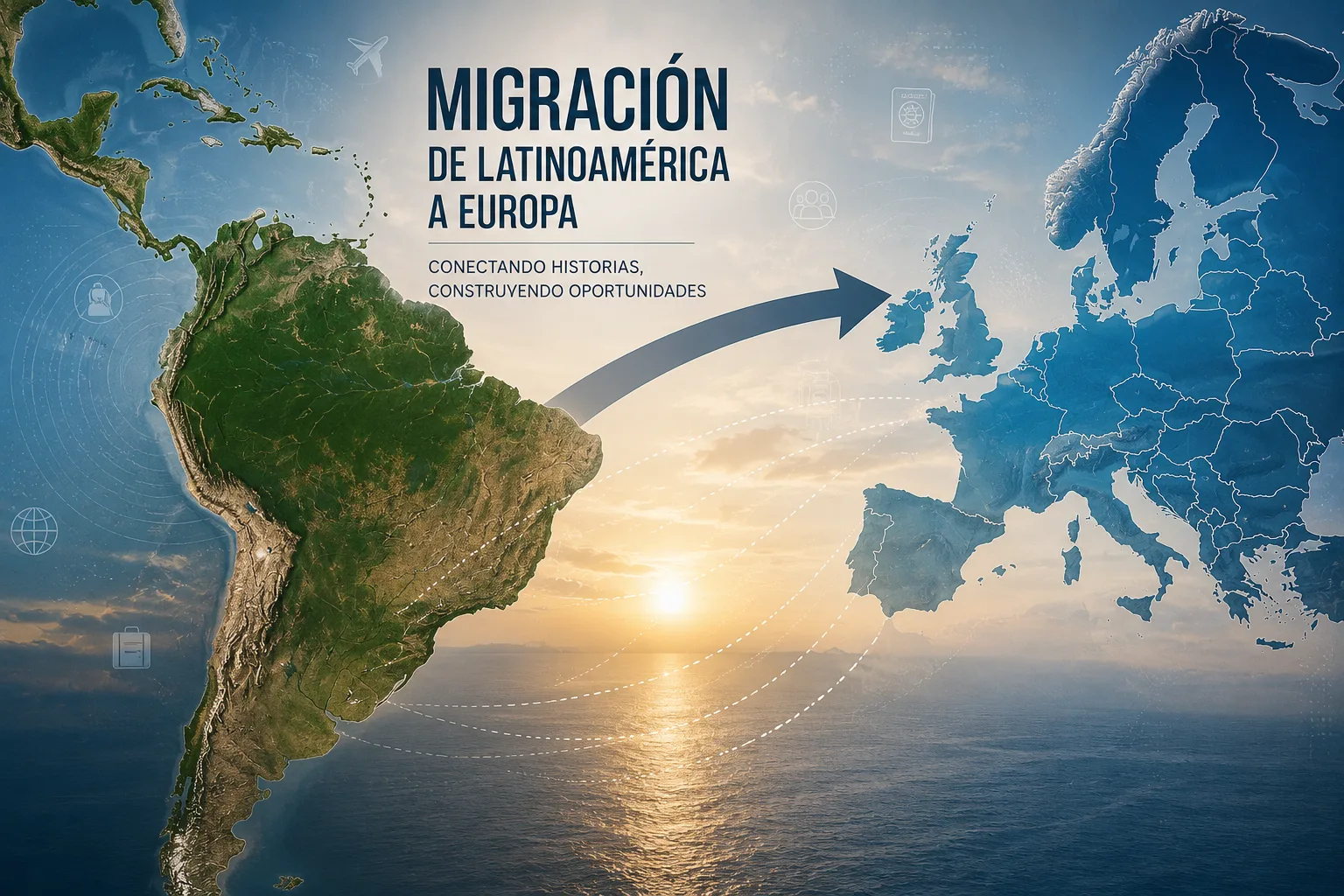
And when talent, market demand and a legal pathway finally meet, the distance between Latin America and Europe becomes much smaller than it appears on the map.