Europe’s Migration Paradox: Closed Borders, Open Jobs
The tragedy in Ceuta highlights Europe's migration contradiction: stronger border controls alongside growing labour shortages and the urgent need for accessible legal pathways to work.
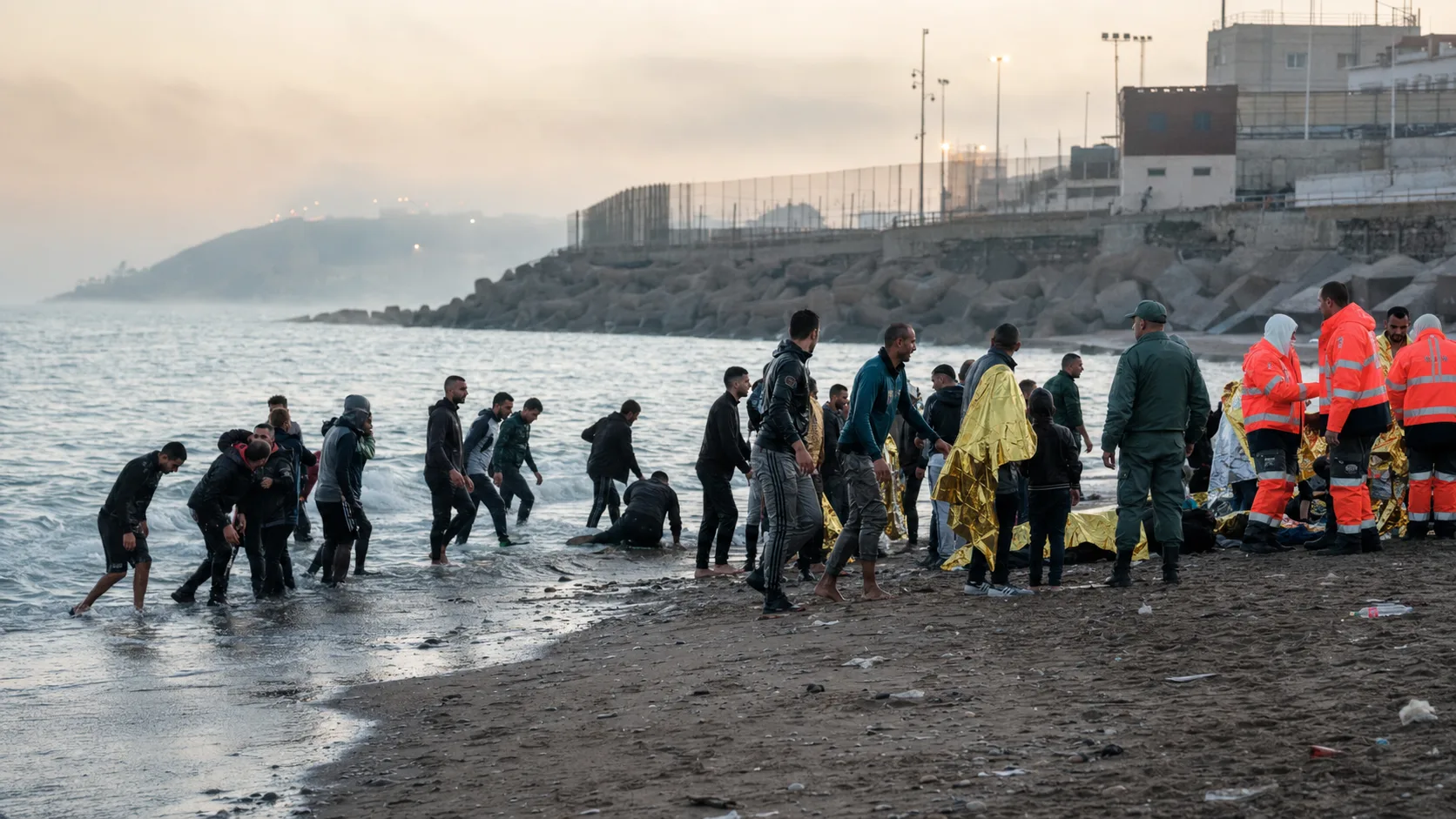
The scenes on Spain’s coast expose a system that is failing both to control its borders effectively and to provide legal pathways for international workers.
The images from Ceuta are difficult to ignore.
In late July, tens of thousands of people attempted to enter the Spanish enclave from Morocco by land and sea. Some swam around border barriers, while others reached the shore exhausted. According to information available from the Spanish authorities on August 1, at least 67 people lost their lives, while most of those who crossed had already returned to Morocco. Spain responded by deploying additional forces and installing a floating barrier along part of the coastline.
For Europe, this is more than another migration crisis. It is a warning about what happens when desperation, misinformation and criminal smuggling networks meet a system that offers too few credible and accessible legal alternatives.
The event also exposes one of Europe’s greatest contradictions. While the continent is trying to stop illegal migration, employers across numerous industries are struggling to find enough workers.
The Numbers Tell Two Different Stories
Dramatic scenes at a border can create the impression that illegal migration is rising everywhere. The broader picture, however, is more complex.
According to Frontex, detections of illegal crossings at the external borders of the European Union fell by 26 percent in 2025, to approximately 178,000. The decline continued during the first months of 2026.
Yet individual events such as the crisis in Ceuta can overwhelm local authorities, dominate political debate and damage public confidence in the entire migration system. A lower annual number of crossings does not make an uncontrolled mass border crossing any less serious.
Europe therefore needs effective border management. It needs faster and fairer asylum decisions, stronger action against smuggling networks and credible procedures for returning people who have no legal right to remain.
Stronger controls alone, however, will not remove the causes of migration. They will not fill Europe’s vacant jobs either.
Europe Is Not Short of People. It Is Short of Functional Legal Pathways.
Recent analysis of the European labour market points to worker shortages in healthcare, construction, transport, hospitality, engineering and many skilled trades. Nurses, electricians, welders, cooks, drivers and machine operators are among the professionals that employers repeatedly struggle to recruit.
One finding from a recent EURES analysis is particularly revealing. Some 98 percent of occupations experiencing a shortage in one European country simultaneously have a surplus of workers in another.
This means that Europe does not simply have a labour shortage. It has a problem connecting people with opportunities.
The skills exist, the jobs exist and people are willing to relocate. What is often missing is a transparent bridge between them.
For a qualified candidate outside the European Union, legal relocation can feel like a maze of disconnected job listings, unfamiliar CV standards, language barriers and unclear documentation requirements.
Employers face obstacles of their own. They need to verify candidates, assess their communication skills and understand national immigration procedures.
When the legal route appears almost inaccessible while smugglers offer a dangerous shortcut, the consequences become visible on beaches and at border crossings.
Border Control And Legal Migration Are Not Opposing Goals
Political debate often presents only two options: open borders or closed borders. This is a false choice.
A sustainable migration policy requires both control and opportunity.
The European Pact on Migration and Asylum, which entered into application in June 2026, was designed to create more consistent procedures for registration, asylum and the sharing of responsibility among member states. This is an important institutional step.
The next step must be equally practical. Legal economic migration should become easier to understand, access and manage where genuine demand for workers exists.
This does not mean that everyone who wants to move to Europe should automatically receive the right to enter. Economic migration must not be confused with asylum, which exists to protect people fleeing persecution and serious danger.
Europe needs a system in which qualified candidates can find genuine employment opportunities, present their skills professionally and follow the correct immigration procedure before desperation pushes them towards an illegal and dangerous route.
GlobalTalent24 As Part Of A Practical Solution

Technology cannot replace immigration law, public institutions or responsible recruitment. It can, however, remove much of the confusion surrounding legal labour mobility.
That is precisely why we are building GlobalTalent24.
Our platform brings the essential parts of an international job search into one structured environment. Candidates can search for employment, create a professional CV and motivation letter, access useful articles and introduce themselves to employers through a video presentation.
A video profile can reveal communication skills, confidence and motivation that are difficult to communicate through a traditional CV. Clear application guidance helps candidates avoid incomplete or unsuitable submissions. Reliable information gives them a more realistic understanding of required qualifications, language expectations and legal procedures.
For employers, a structured process provides an opportunity to evaluate candidates according to their skills, experience and readiness to relocate. This saves time and improves the chances of finding someone who genuinely meets the needs of the position.
GlobalTalent24 cannot guarantee anyone a visa or replace the decisions of employers and immigration authorities. Our role is to make the legal route more visible, organised and accessible.
That distinction matters.
The Lesson From Spain’s Coast
The tragedy in Ceuta should not be used to dehumanise migrants, but neither should it be accepted as an unavoidable part of modern migration. Every life lost at a border represents a failure somewhere along the route. It may be a failure of information, diplomacy, security, opportunity or protection.
Europe has both the right and the responsibility to control its external borders. At the same time, it has an economic interest in attracting people whose skills are needed by its labour market.
These two objectives can support each other.
A credible legal migration system reduces the space in which smugglers operate. Better connections between workers and employers can transform migration from an improvised crisis into a managed economic process. Clear rules protect local communities, legitimate asylum seekers, international candidates and responsible businesses.
The real question is not whether Europe will continue to experience migration. Demographic change, labour shortages and global inequality have already provided the answer.
The question is whether migration will continue to arrive through chaos or increasingly take place through transparent and legal systems based on the genuine needs of the labour market.
The scenes on Spain’s coast show the cost of making the wrong choice.