Spain faces a new climate equation: Wildfires are reshaping the economics of risk
Wildfires in Spain are no longer only an environmental issue: rising climate risk is changing insurance, property, tourism and public finances.
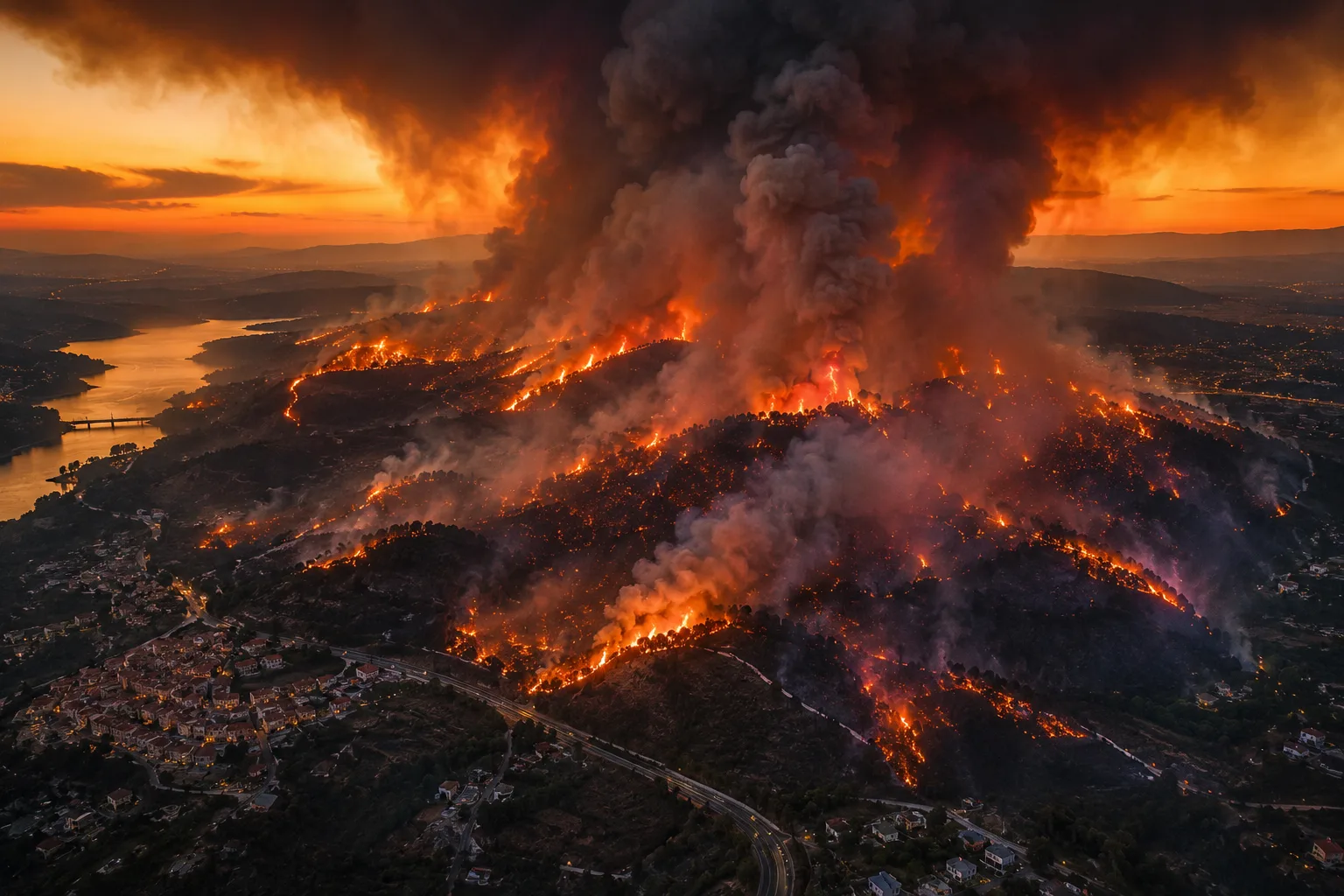
Wildfires in Spain are no longer only an environmental and safety problem. Growing exposure to extreme weather is raising questions about insurance, property values, tourism and public finances, showing how climate change is acquiring a concrete economic price.
GlobalTalent24 Team
August traditionally marks the peak of Spain’s tourist season. Beaches are crowded, hotels report high occupancy, airports operate under heavy pressure, and millions of foreign visitors arrive in a country that for decades has built its international image around sunshine, the coast and the Mediterranean way of life. In recent years, however, the Spanish summer has increasingly been accompanied by a different picture, with temperatures approaching or exceeding 40°C, smoke over mountainous areas, evacuations and major firefighting operations.
According to the latest data from Spain’s Ministry for the Ecological Transition and the Demographic Challenge, fires had affected approximately 254,730 hectares of forest land by 17 August 2026. Forty-two large wildfires were recorded, together affecting more than 223,000 hectares. By mid-August, state firefighting aircraft had spent 8,753 hours in the air, 78 percent more than during the same period a year earlier.
These figures reveal an important shift in how the consequences of extreme weather should be viewed. The area burned remains an important indicator, but on its own it no longer says enough about the true cost of wildfires. The more complex the conditions become, the more people, aircraft, equipment and money the state must deploy to protect settlements, infrastructure and economic activity. Climate risk is therefore gradually moving from environmental statistics into economic calculations.
A fire does not end when the flames are out
A major wildfire does not destroy vegetation alone. Its consequences can extend to homes, farmland, roads, electricity infrastructure, tourist facilities and entire local economies. Even when settlements remain physically intact, road closures, evacuations, smoke and disruption to the tourist season can leave financial consequences that are felt long after firefighting units have left the area.
This is precisely why climate change is attracting growing attention from institutions that traditionally were not at the centre of the environmental debate. Banks, insurance companies, investors and central banks are trying to assess how more frequent extreme events will change asset values and the price of risk.
According to the European Environment Agency, whose data were used by Reuters in its analysis, weather and climate extremes caused around €822 billion in economic losses in Europe between 1980 and 2024. Particularly concerning is that roughly a quarter of the total damage occurred during the final four years of that period, while only around a quarter of Europe’s climate-related losses were covered by insurance.
For European governments, this represents a serious problem. Damage that is not covered by private insurance does not disappear from the economic system. Part of it is borne by citizens and companies, while a significant share of the costs ultimately shifts to the state through infrastructure reconstruction, assistance to affected areas and various support programmes.
Insurance becomes a key indicator
Spain has a developed and distinctive system of protection against major disasters, in which the public Consorcio de Compensación de Seguros plays an important role. It would therefore be misleading to claim that the country faces an immediate scenario in which large numbers of properties will simply become uninsurable.
The more relevant question is how the price of risk will change if wildfires, floods, droughts and extreme temperatures become more frequent or more intense.
Insurance companies do not base their assessments solely on what happened during a single summer. They consider the long-term probability of loss, the location of the property, access to firefighting infrastructure, terrain characteristics and the expected cost of future events. If estimated risk rises, the consequences can appear in the form of higher premiums, stricter insurance conditions or greater requirements for property owners.
Reuters has pointed during this year’s European wildfire season to the widening gap between total climate losses and the share covered by insurance. For Spain, this is particularly relevant because of the combination of a large property stock, a strong international holiday-home market and extensive areas exposed to wildfires, floods or extreme temperatures.
The change may not be abrupt, but markets rarely wait for a problem to become catastrophic before beginning to price it in.
A new dimension for property markets
Spain’s property market has long rested on several exceptionally strong advantages. Climate, coastline, quality of life and relatively good connections with the rest of Europe have made the country one of the most attractive destinations for foreign buyers, retirees, investors and people who can work remotely.
Climate risk does not cancel out those advantages, but it adds a new dimension.
A house on the edge of a forest may offer views and privacy that increase its market value, while the same location may require more serious wildfire protection. A coastal property may be highly attractive while at the same time carrying greater long-term exposure to flooding, erosion or extreme weather events. In some parts of the country, water availability could also become an increasingly important factor in assessing the long-term value of property.
Climate exposure could therefore become almost as natural a part of property valuation in the coming years as energy efficiency, transport connections or the quality of local infrastructure. This does not mean that attractive parts of Spain will lose buyers, but rather that two apparently similar properties may increasingly carry different values precisely because their levels of climate risk differ.
This also matters to banks. Property is not only a home but also collateral for a mortgage. If long-term risk can affect its value or the cost of insuring it, climate exposure becomes relevant to the financial sector as well.
Tourism remains a strength, but adaptation will matter
For Spain, the climate issue is particularly sensitive because it intersects with one of the most important sectors of its economy. The country is one of the world’s largest tourist destinations, and sunshine and warm weather have represented one of its greatest competitive advantages for decades.
There is, however, a difference between pleasantly warm weather and prolonged periods of extreme heat.
If temperatures in July and August increasingly become uncomfortable for sightseeing, outdoor activities or active tourism, part of demand may begin to shift toward spring and autumn. Such a development would not necessarily be negative for Spain. A longer season could reduce the concentration of tourists in a few summer weeks and allow hotels, restaurants and other businesses to operate more steadily through a larger part of the year.
The problem is more complex in areas that depend directly on nature. Rural tourism, campsites, hiking destinations and tourist facilities close to forests are particularly vulnerable to wildfires. Even when a property itself is not threatened, several days of road closures or poor air quality can be enough to trigger booking cancellations in the most important part of the season.
Spain is therefore unlikely to lose its position as a major tourism power, but climate adaptation will become an increasingly important part of its ability to retain that position.
A growing bill for the state
Perhaps the most important consequence of this shift will not be visible on beaches or in the property market, but in public finances.
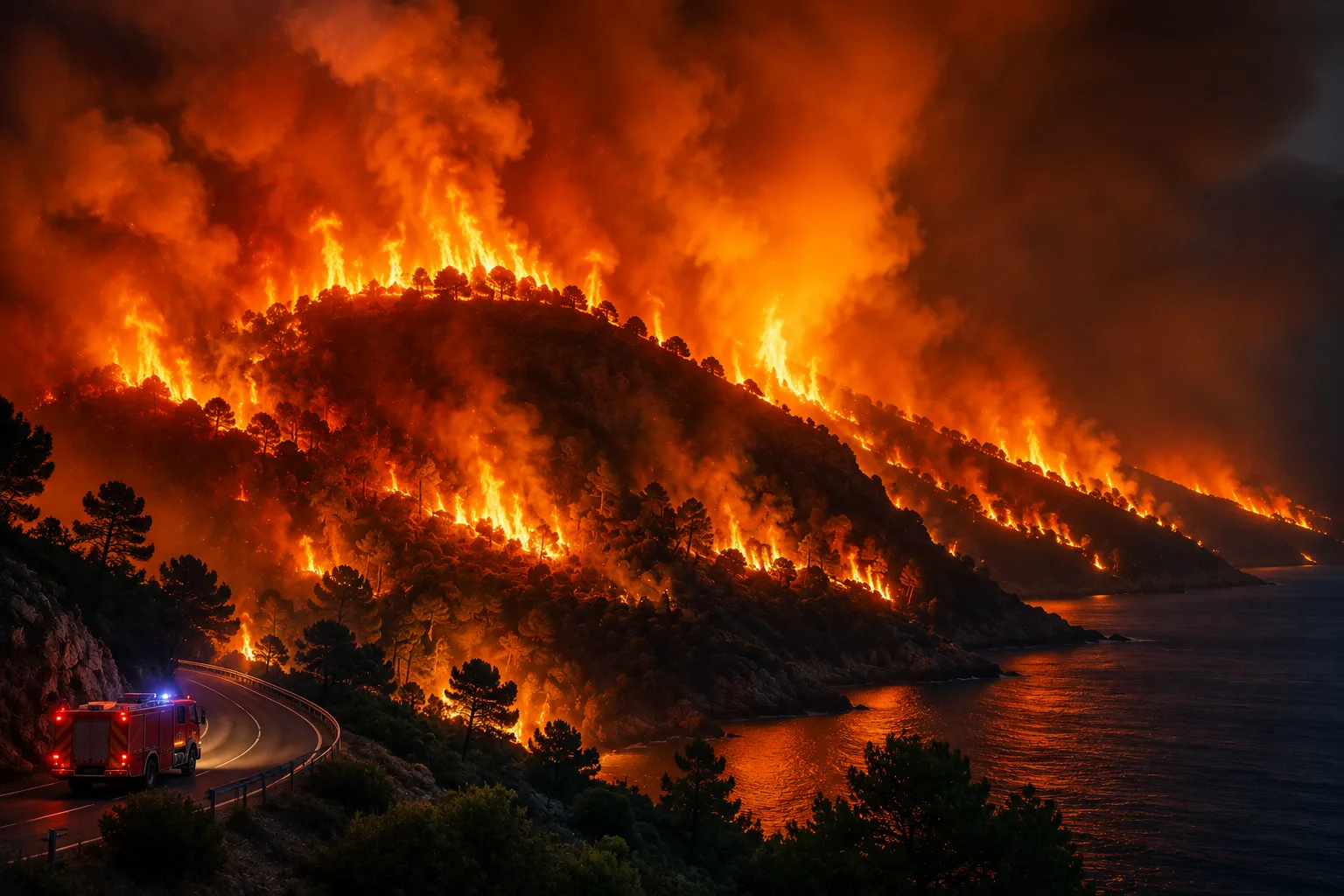
Major wildfires require firefighting units, aircraft, helicopters, police, the military, health services and logistics. After the fire come infrastructure reconstruction, assistance to households, land restoration and measures intended to prevent future disasters. At the same time, prevention requires forest maintenance, better early-warning systems, spatial planning and investment in more resilient infrastructure.
This means that the state is increasingly financing not only the response to an individual disaster but a long-term system of adaptation to new climate conditions.
The problem for Spain, as for other European countries, is that this bill is arriving at a time when public finances are already burdened by other major demands. Europe is increasing defence spending, investing in the energy transition, financing an ageing population and trying to preserve industrial competitiveness. Climate adaptation is now joining that list as a cost that is becoming increasingly difficult to postpone.
In that sense, Spain’s wildfires form part of a much broader European story. Italy, Portugal, Greece and southern France face a similar combination of extreme temperatures, wildfires, drought and pressure on water resources. What makes Spain particularly important is the size of its economy and the fact that sectors such as tourism and property are closely connected to the very climate that is changing.
Spain is entering an era in which resilience has a price
There is little reason to argue that wildfires alone will fundamentally change Spain’s attractiveness. The country will continue to have a strong tourism industry, attractive cities, developed infrastructure and a property market that draws buyers from across much of Europe. It is far more likely that change will unfold gradually, through the way insurers assess risk, banks value property, investors choose locations and the state decides where it must invest more in protection.
That is precisely why this year’s wildfire season matters beyond the immediate damage it leaves behind. It shows that climate change can no longer be measured only in temperatures and hectares of burned forest. Its consequences are increasingly entering the price of insurance, infrastructure maintenance, tourism operations and property ownership.
Spain’s main challenge will be to preserve the economic advantages its climate provides while investing enough to reduce the risks that the same climate increasingly creates. If it succeeds, adaptation can become another element of its long-term competitiveness. If investment is delayed, the costs will gradually spill over to households, companies and public finances.
Wildfires therefore represent much more than a seasonal emergency. They are among the first visible indicators of how the economy of southern Europe will adapt to a world in which climate is no longer only part of quality of life and the tourism offer, but a factor influencing the price of capital, property and long-term security.
GlobalTalent24 Team
Official sources
Spain’s Ministry for the Ecological Transition · European Environment Agency · European Central Bank · Consorcio de Compensación de Seguros · Reuters