Health Insurance in Switzerland: Models, Deductibles and Costs
How do basic insurance, family doctor, HMO and Telmed models work? A guide to deductibles, retention fees and supplementary insurance in Switzerland.

Why health insurance matters in Switzerland
Anyone living in Switzerland must generally take out compulsory health insurance. At the same time, insured people can choose their provider, insurance model and annual deductible. This combination of mandatory coverage and individual choice makes careful comparison especially important.
The right option depends on more than the monthly premium. Preferred access to doctors and specialists, expected healthcare costs and available financial reserves should also be considered.
What does compulsory basic insurance cover?
The benefits included in basic insurance are defined by the Swiss Federal Health Insurance Act (KVG/LAMal). All authorised health insurers must therefore reimburse the same benefits required by law.
The main differences between providers concern premiums, available insurance models, invoice processing and customer service. Premiums vary according to factors such as place of residence, age group, insurance model, accident coverage and the selected deductible.
Important: health insurers must accept applicants for basic insurance regardless of their age or health. Different rules apply to optional supplementary insurance.
Comparing Swiss health insurance models
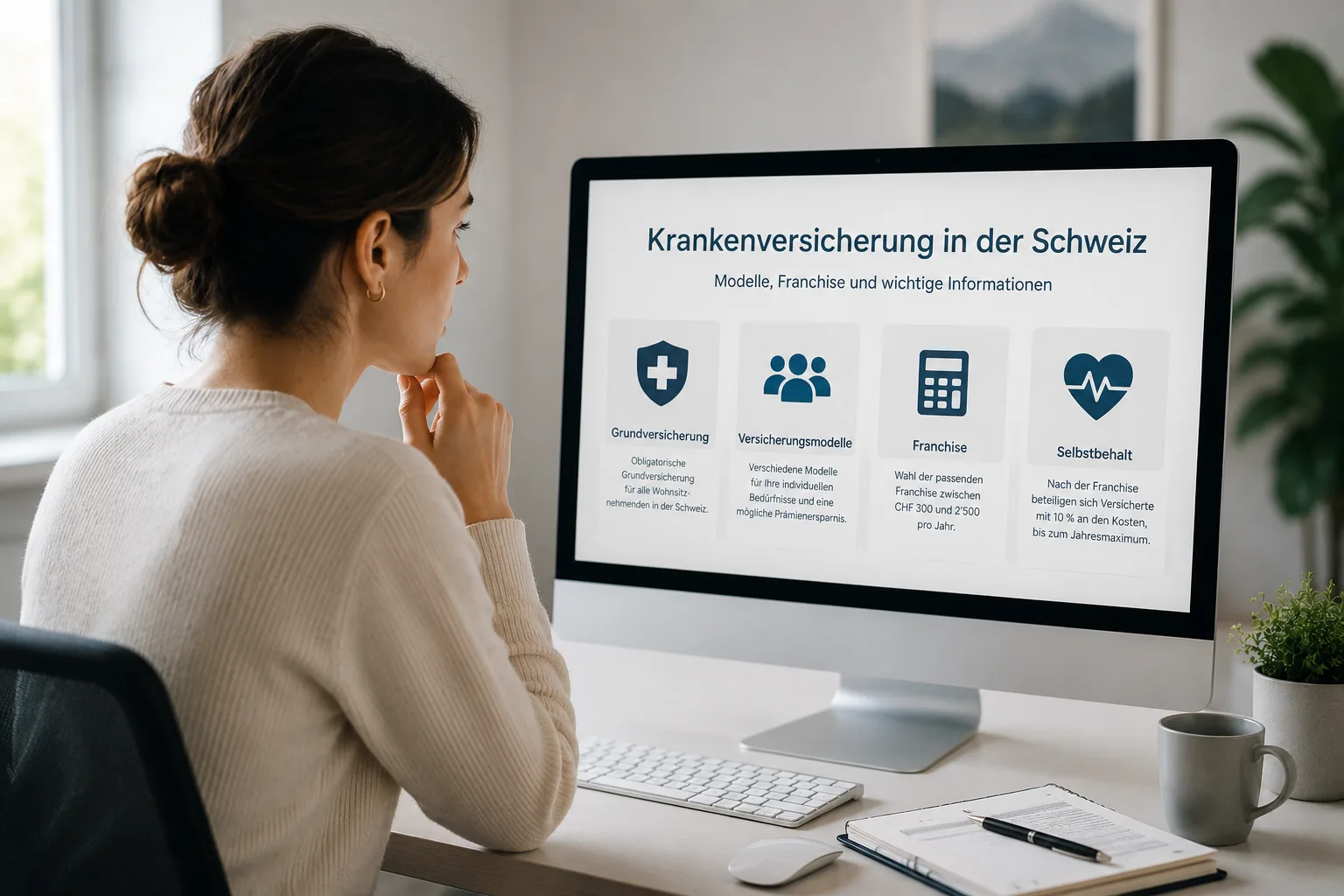
Standard model
The standard model generally offers a free choice among authorised healthcare providers. Insured people can consult a doctor or another healthcare professional directly. This flexibility usually comes with a higher premium.
Family doctor model
Under the family doctor model, the selected medical practice is normally the first point of contact. The doctor coordinates treatment and refers the patient to a specialist when necessary. Exceptions for emergencies, gynaecological check-ups or eye care depend on the insurer’s specific terms.
HMO model
With an HMO model, insured people first contact a designated health centre. Different medical specialties often work together at the same location. Coordinated care can simplify treatment and reduce the insurance premium.
Telmed model
Under a Telmed model, the first medical consultation usually takes place by telephone or through a digital service. The advisory centre recommends the next steps and, depending on the model, decides whether a medical appointment is needed and which provider should be consulted.
Failure to follow the required procedure under an alternative model may result in reduced reimbursement or other consequences, depending on the policy terms. It is therefore essential to read the model rules carefully.
Annual deductible: which amount can you choose?
The deductible is the amount an insured person pays during each calendar year before basic insurance starts contributing to covered healthcare costs.
Adults can choose from six deductibles: CHF 300, 500, 1,000, 1,500, 2,000 or 2,500. The standard deductible is CHF 300. Different levels apply to children, who are not required to have a deductible.
As a general rule, a higher deductible reduces the monthly premium but increases the financial risk in the event of illness. A low deductible may suit people who regularly use medical services. A high deductible is more suitable for people who expect low healthcare costs and have sufficient financial reserves.
When comparing policies, do not consider the monthly premium alone. The potential total cost — annual premiums, the deductible and the retention fee — is what matters.
Retention fee and hospital contribution
Once the deductible has been reached, adults generally pay 10% of additional covered costs. This retention fee is capped at CHF 700 per calendar year; the maximum for children is CHF 350.
For an inpatient hospital stay, a contribution of CHF 15 per day generally applies. Exemptions include children, young adults up to age 25 who are in education or training, and women receiving maternity-related benefits.
Not every healthcare expense is automatically covered. Services outside the statutory catalogue and special cost-sharing rules may result in additional out-of-pocket costs.
Supplementary insurance: optional additional coverage
Supplementary insurance can cover benefits that go beyond compulsory basic insurance. Depending on the policy, these may include alternative treatments, contributions towards glasses or fitness activities, broader hospital choice or additional comfort during a hospital stay.
Unlike basic insurance, benefits and admission criteria are not standardised. Insurers may ask health questions, reject applications or apply exclusions. Benefits, exclusions, cancellation periods and possible premium changes should therefore be reviewed carefully before taking out a policy.
Basic and supplementary insurance do not have to be purchased from the same provider.
Frequently asked questions about Swiss health insurance
Which health insurer offers the best benefits?
The statutory benefits under basic insurance are the same with every authorised health insurer. The main differences are premiums, models, service and administrative processes.
When is a high deductible worthwhile?
A high deductible can be worthwhile when expected healthcare costs are low. However, insured people should have enough money available to cover both the deductible and the maximum retention fee if they become ill.
Can you change health insurers?
Yes. Basic health insurance can be changed subject to the applicable notice periods. Before switching, compare the model, deductible, premium and availability in your region.
Do family doctor, HMO and Telmed models provide less coverage?
No. The benefits covered by law remain the same. The main difference is which service must be contacted first and how treatment is coordinated.
Conclusion: compare the model and deductible together
Choosing the right health insurance depends on the interaction between the premium, deductible, care model and personal circumstances. People who value unrestricted access to doctors often pay more under the standard model. Family doctor, HMO and Telmed models may cost less but require insured people to follow a defined care pathway.
Before making a decision, compare the potential total annual costs and the detailed terms of each model. This makes it easier to find an option that suits both your healthcare needs and your budget.
Sources: Federal Office of Public Health: premiums and co-payment, FOPH: key points about health insurance and the Swiss Federal Health Insurance Act.