Salaries in Switzerland in 2026: From Care Workers to Doctors and IT Specialists
How much people earn in Switzerland today, which professions offer the highest incomes and why the same gross salary does not provide the same standard of living in every canton.

The GlobalTalent24 team examined how much people earn in Switzerland today, which professions offer the highest incomes and why the same gross salary does not provide the same standard of living in every canton. Official data reveals a labour market where the median salary exceeds 7,000 francs, but also a system with no single minimum wage for the entire country.
Switzerland has a reputation for exceptionally high salaries. The figures largely confirm that reputation, but only a closer look reveals how complex the Swiss labour market really is.
Profession is only the first part of the calculation. Qualifications, experience, canton, employer, working hours and the specific position can create differences of several thousand francs a month. Two people with similar educational backgrounds therefore do not necessarily have even approximately the same income.
The latest official figures provide a useful starting point.
According to Bundesamt für Statistik (BFS), the Swiss Federal Statistical Office, the median gross monthly salary for full-time employment in 2024 was 7,024 Swiss francs.
This figure represents the midpoint of the Swiss labour market. Half of employees earn less and half earn more than 7,024 francs gross per month.
This, however, is where the more interesting part of the story begins. The national median does not show what a nurse with three years of experience, a construction worker, an IT specialist or a young doctor can expect. Answering that question requires a much closer look at the profession, qualifications and working conditions.
What Salarium is and how Switzerland tracks salaries
One of the most important official tools for estimating earnings is Salarium, the statistical salary calculator of the Swiss Federal Statistical Office.
It is based on the Schweizerische Lohnstrukturerhebung (LSE), the Swiss Earnings Structure Survey. The current model uses data for 2024.
Salarium does not work like a simple list of professions with one “average salary” beside each of them. It considers a range of information about the employee and the job, including occupation, industry, region, education and professional profile.
This is important for interpreting the figures correctly.
There is no single salary received by every doctor, IT specialist or care worker in Switzerland. Two people with the same job title may earn noticeably different amounts.
For this reason, this overview provides approximate gross monthly ranges for employees with around two to three years of experience. They serve as a realistic guide, while an actual offer may vary depending on qualifications, canton, company or institution and the specific role.
A high-salary country without a national minimum wage
Perhaps the most interesting fact for anyone researching the Swiss labour market for the first time is that the country has no single statutory minimum wage at federal level.
In other words, there is no one minimum hourly rate that automatically applies from Geneva to Zurich.
Minimum wages may be regulated by collective agreements and the rules of individual industries, while certain cantons have introduced their own statutory minimums.
Geneva is the best-known example. From 1 January 2026, the minimum gross wage in the canton is 24.59 Swiss francs per hour.
For a 40-hour working week, this is approximately 4,260 francs gross per month.
However, this figure should not be described as the “Swiss minimum wage”.
In the canton of Basel-Stadt, or Basel-City, the minimum wage for 2026 is 22.20 francs per hour. In the canton of Neuchâtel it is 21.35 francs, while Jura has a minimum hourly rate of 21.40 francs. Ticino applies a system in which the minimum hourly rate depends on the industry.
This example already demonstrates one of the fundamental rules of the Swiss labour market: it matters not only what you do, but also where you work.
Care assistant

Pflegehelfer or Pflegehelferin means a care assistant. The designation Pflegehelfer/in SRK is also common and refers to support staff with the relevant training from the Swiss Red Cross.
For an employee with approximately two to three years of experience, the indicative gross salary is around 4,500 to 5,000 Swiss francs per month.
Different jobs sit within this range. Support staff work in care homes, long-term care facilities, hospitals and through Spitex, the organised system of health and social care provided in a patient’s home.
Shift work can significantly change the final monthly income. Nights, Sundays and public holidays may attract additional payments, so the basic salary does not necessarily represent the employee’s total earnings.
For workers arriving from abroad, another detail is important. The job title in an advertisement is not enough. They should check the qualification under which they will be employed and exactly what is stated in the contract.
Nurse
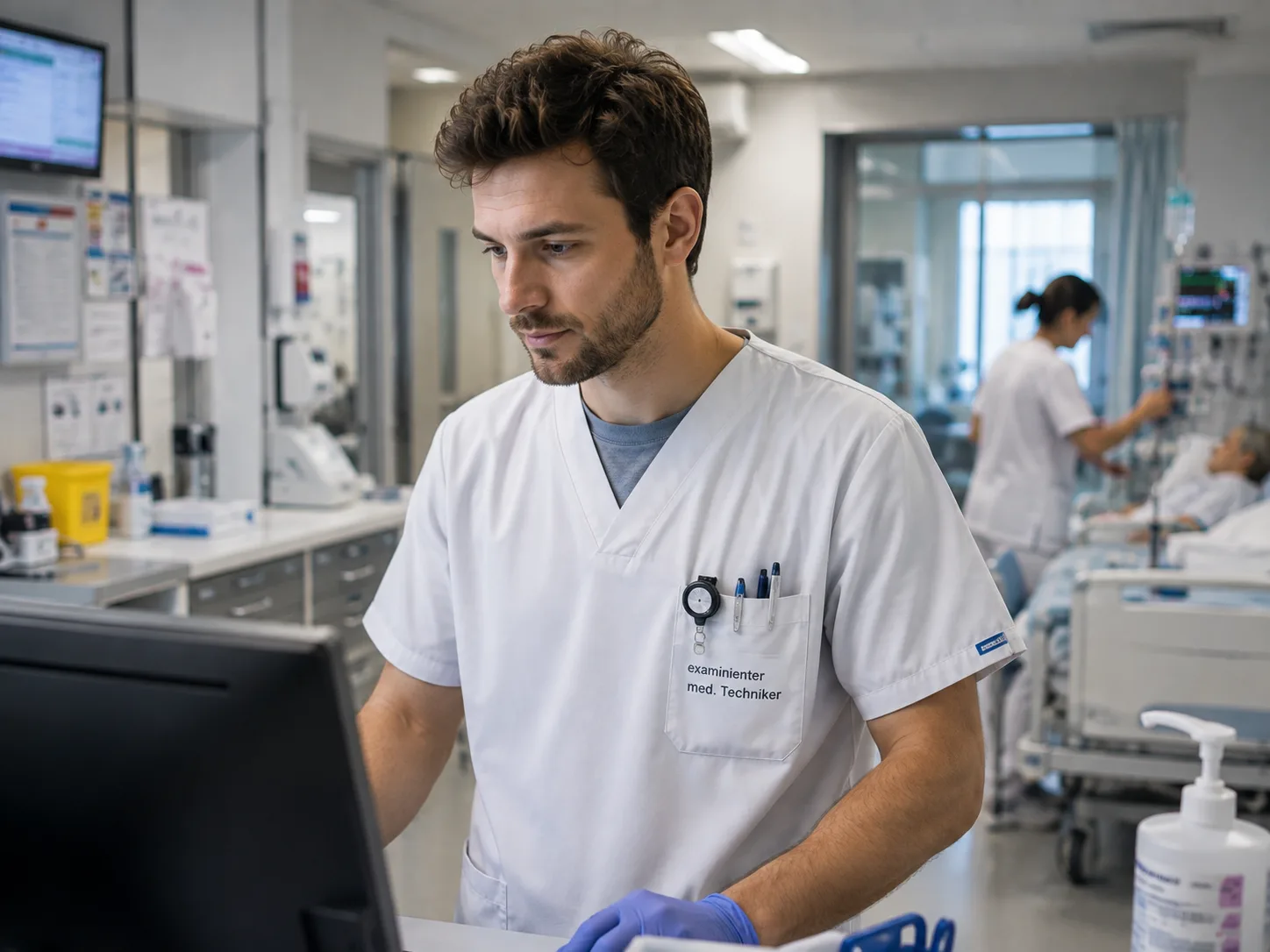
Diplomierte Pflegefachfrau and diplomierter Pflegefachmann are the terms for qualified healthcare professionals, most closely corresponding to a registered nurse.
The difference from support staff is not limited to responsibility. It is also visible on the payslip.
For a qualified nurse with two to three years of experience, the indicative gross salary can range between 5,800 and 6,700 Swiss francs per month.
Annual gross earnings can therefore exceed 70,000 francs, particularly if the contract provides for a 13th salary payment. Shift work, nights, Sundays and public holidays may increase the total further.
For people who completed their education abroad, recognition of their professional qualification is crucial.
A diploma from another country does not in itself guarantee that an employee will immediately be placed at the same professional and salary level as someone with the corresponding recognised qualification in Switzerland.
For this reason, the gross salary is only one part of a healthcare job offer. It is equally important to check the professional function under which the person will be employed.
Construction worker

Bauarbeiter or Bauarbeiterin means construction worker, but the term covers a wide range of jobs with different levels of knowledge and responsibility.
A worker with approximately two to three years of experience can expect an indicative gross salary of 5,000 to 6,000 Swiss francs per month.
However, a general labourer, bricklayer, carpenter, steel fixer and construction machinery operator do not necessarily belong to the same pay grade.
In the German-speaking region, the terms Maurer for bricklayer and Zimmermann for carpenter are frequently used.
Construction has another important characteristic. For a large part of the main construction sector, working conditions and minimum wages are governed by the Landesmantelvertrag (LMV), the national collective agreement for the construction industry.
This means that salary does not depend only on the cantonal minimum. Professional qualifications, pay grade and the rules of the collective agreement applying to the particular job are also important.
In addition to basic pay, employees should check allowances for transport and meals, overtime, special working conditions and the 13th salary.
For a construction worker, one of the most important terms in the contract is therefore not only the figure beside the word “salary”, but also the pay grade in which the worker is classified.
IT specialist

Informatiker or Informatikerin means IT specialist, but few professions include such different salary levels under a single title.
For an IT specialist with two to three years of professional experience, indicative gross monthly earnings may range between 6,500 and 8,000 Swiss francs.
The employee’s specific work can make an enormous difference.
Technical support and traditional systems administration are not the same market as software development, cloud infrastructure, cybersecurity, data engineering or work related to artificial intelligence.
The industry also matters.
An IT specialist employed by a bank, pharmaceutical company or large technology company may receive a different package from someone with similar experience working for a smaller employer.
Zurich, Basel and Geneva have a strong concentration of companies employing highly qualified IT specialists. At the same time, these are locations where the cost of living can be very high.
For this reason, it is worth looking at the annual package in IT offers. The monthly salary says a great deal, but a bonus, 13th salary and other benefits can change the value of the offer.
Bank employee

Bankkaufmann or Bankkauffrau means bank employee, but in a country known for banking this profession is a good example of why one figure is often not enough.
For an employee with approximately two to three years of experience, the indicative gross salary may range from 6,000 to 7,500 Swiss francs per month.
However, there may be a substantial difference between a retail banking employee, a client adviser, a credit analyst and a specialist in private banking or wealth management.
Zurich and Geneva, two internationally important financial centres, play a special role.
In certain positions, fixed salary represents only one part of total earnings. Bonuses and other variable payments can significantly increase annual income, particularly as a career progresses.
A banking offer should therefore be assessed using two figures: the guaranteed fixed salary and the expected total annual compensation.
Doctor

Arzt or Ärztin means doctor. When it comes to earnings, however, the doctor’s position is a much more important question.
Assistenzarzt or Assistenzärztin is a doctor in specialist training. Oberarzt or Oberärztin refers to a senior physician, while Chefarzt or Chefärztin is a chief physician or head of a clinic or department.
A young doctor in specialist training with approximately two to three years of experience can expect a gross salary of around 7,500 to 9,000 Swiss francs per month.
Even at this stage of a career, annual gross earnings can reach or exceed 90,000 francs. Completing specialist training, taking on greater responsibility and advancing professionally open access to considerably higher pay grades.
On-call duties and additional shifts may also affect total earnings.
For a doctor who qualified abroad, however, the level of a Swiss salary is not the first issue to resolve.
Recognition of professional qualifications is essential. The Medizinalberufekommission (MEBEKO), or Medical Professions Commission, is responsible for matters concerning foreign medical diplomas. The procedure depends, among other things, on the country in which the diploma was obtained and the candidate’s individual situation.
Only once the professional requirements have been met does comparing salaries become truly meaningful.
Another distinction is also necessary. The salary of a doctor employed by a hospital is not the same as the income of a doctor running a private practice. The turnover of a private practice includes staff, premises, equipment, insurance and operating costs, so it cannot be treated as personal earnings.
A salary of 7,000 francs does not mean 7,000 in the bank
A high gross salary looks impressive, but only the net amount reveals part of the true financial picture.
Contributions to the Swiss social insurance system are deducted from earnings. These include AHV/AVS, the old-age insurance scheme; IV/AI, disability insurance; and ALV/AC, unemployment insurance. Occupational pension provision is another important item.
This leads to another Swiss characteristic: taxes are not the same everywhere.
The final tax burden depends on the canton and municipality of residence, as well as the employee’s personal and family circumstances.
Quellensteuer, or withholding tax deducted directly from salary, applies to some foreign workers.
Two people with an identical gross salary of 7,000 francs therefore do not necessarily have the same amount available at the end of the month.
Switzerland’s tax system, contributions and the calculation of net salary will be examined in greater detail in a separate article.
A high salary comes with high costs
There is another figure that does not appear on a payslip but can dramatically change the value of a good job offer: the cost of living.
Zurich and Geneva offer exceptional professional opportunities and high earnings, but they are also among the more expensive places to live. Housing can take a large share of the monthly budget, while food, transport and other everyday expenses must also be added.
Health insurance occupies a particularly important place.
Mandatory basic health insurance is a separate and substantial household expense. Consequently, even the amount left after taxes and social contributions does not yet show how much money a family genuinely has available for other needs.
Salary should therefore be considered together with place of residence and living costs. An offer of 7,000 francs in one city may not have the same real value as the same salary in another location.
Why the 13th salary matters more than it seems
Swiss job offers contain another detail that can easily change the calculation: the 13th salary.
If an employee earns 7,000 francs a month and the contract provides for 13 salary payments, annual gross earnings are not 84,000 but 91,000 Swiss francs.
The difference is 7,000 francs a year.
Two offers should therefore not be compared only by monthly salary. Total annual gross earnings provide a much more accurate picture.
The same applies to bonuses, allowances for shift and night work, work on Sundays and public holidays, overtime and other payments.
What the figures really say about working in Switzerland
Switzerland is indeed a high-income labour market. The official median gross salary of 7,024 francs per month demonstrates this clearly.
Behind this single figure, however, lies a far more complex picture.
A care assistant with several years of experience may expect approximately 4,500 to 5,000 francs gross, a construction worker around 5,000 to 6,000, and a qualified nurse roughly 5,800 to 6,700 francs.
For IT specialists, the range rises to about 6,500 to 8,000 francs, while a young doctor in specialist training with several years of experience may fall within a range of approximately 7,500 to 9,000 francs gross per month.
Perhaps the most important conclusion, however, is not which profession has the highest figure.
For anyone considering work in Switzerland, it is far more important to understand what that figure means after taxes, health insurance and living costs, which qualification will be recognised and how much the employer’s complete annual package is worth.
Only then does a Swiss salary stop being an impressive number and become information on which a serious decision can be based.
Sources
Bundesamt für Statistik (BFS): Schweizerische Lohnstrukturerhebung (LSE) 2024 and Salarium, the official statistical salary calculator.
Minimum wages: official data from the relevant Swiss cantons for 2026.
Construction: Landesmantelvertrag (LMV), the collective agreement for the main construction sector.
Healthcare professions: Bundesamt für Gesundheit (BAG) and Medizinalberufekommission (MEBEKO).