Swiss glaciers are disappearing: Melting is transforming the Alps
Switzerland has lost about 30 cubic kilometres of glacier ice since 2000. In 2026, another 20 to 30 small glaciers could disappear completely, while the effects are already being felt in water supplies, safety, infrastructure and tourism.
Research and analysis: the GlobalTalent24 team.
Switzerland has lost about 30 cubic kilometres of glacier ice since 2000. In 2026, another 20 to 30 small glaciers could disappear completely, while the effects are already being felt in water supplies, safety, infrastructure and tourism.
Swiss glaciers have entered another critical melt season. According to glaciologist Matthias Huss, director of Glacier Monitoring in Switzerland, GLAMOS, the remaining ice on approximately 20 to 30 small glaciers could disappear completely in 2026.
The pressure began unusually early. Winter snow reserves were exhausted by 29 June, the date known as Glacier Loss Day, meaning the point when further melting directly reduces old glacier ice. On the Gries Glacier in the canton of Valais, a local ice-thickness loss of about six metres was measured during the 2024/25 glaciological year. That figure does not refer to the summer of 2026, but it clearly shows the pace of change.
A quarter of the ice disappeared in ten years
According to the 2025 GLAMOS annual report, Switzerland had about 45.1 cubic kilometres of glacier ice at the end of that year, roughly 30 cubic kilometres less than in 2000. Glacier area had fallen to about 755 square kilometres, a decline of approximately 30 per cent.
The acceleration matters even more than the total. Around 10 per cent of the existing ice volume disappeared in the decade ending in 2000. The loss was 14 per cent from 2000 to 2010, around 17 per cent from 2010 to 2020 and as much as 24 per cent between 2015 and 2025. The year 2025 alone brought another three per cent loss, equivalent to about 1.4 cubic kilometres of ice.
The most dramatic years were 2022 and 2023, when about ten per cent of the total volume vanished in only two years. The Swiss Academy of Sciences said that roughly as much ice was lost in those two years as during the three decades between 1960 and 1990. More than a thousand small glaciers have already disappeared.
Less ice means a different water regime
Glaciers are more than scenery. They are natural reservoirs that store precipitation and release water during hot, dry months. The National Centre for Climate Services, NCCS, says glacier water makes an important contribution to the summer flow of major Alpine rivers, including the headwaters of the Rhine and Rhône.
This creates a dangerous paradox. Intense melting temporarily increases the amount of water, but only while enough ice remains. GLAMOS estimates that the peak amount of meltwater Swiss glaciers can provide has probably already passed. As the ice reserve shrinks, future droughts will bring less additional water for hydropower, agriculture, ecosystems and transport.
The mountains are losing their frozen binding agent
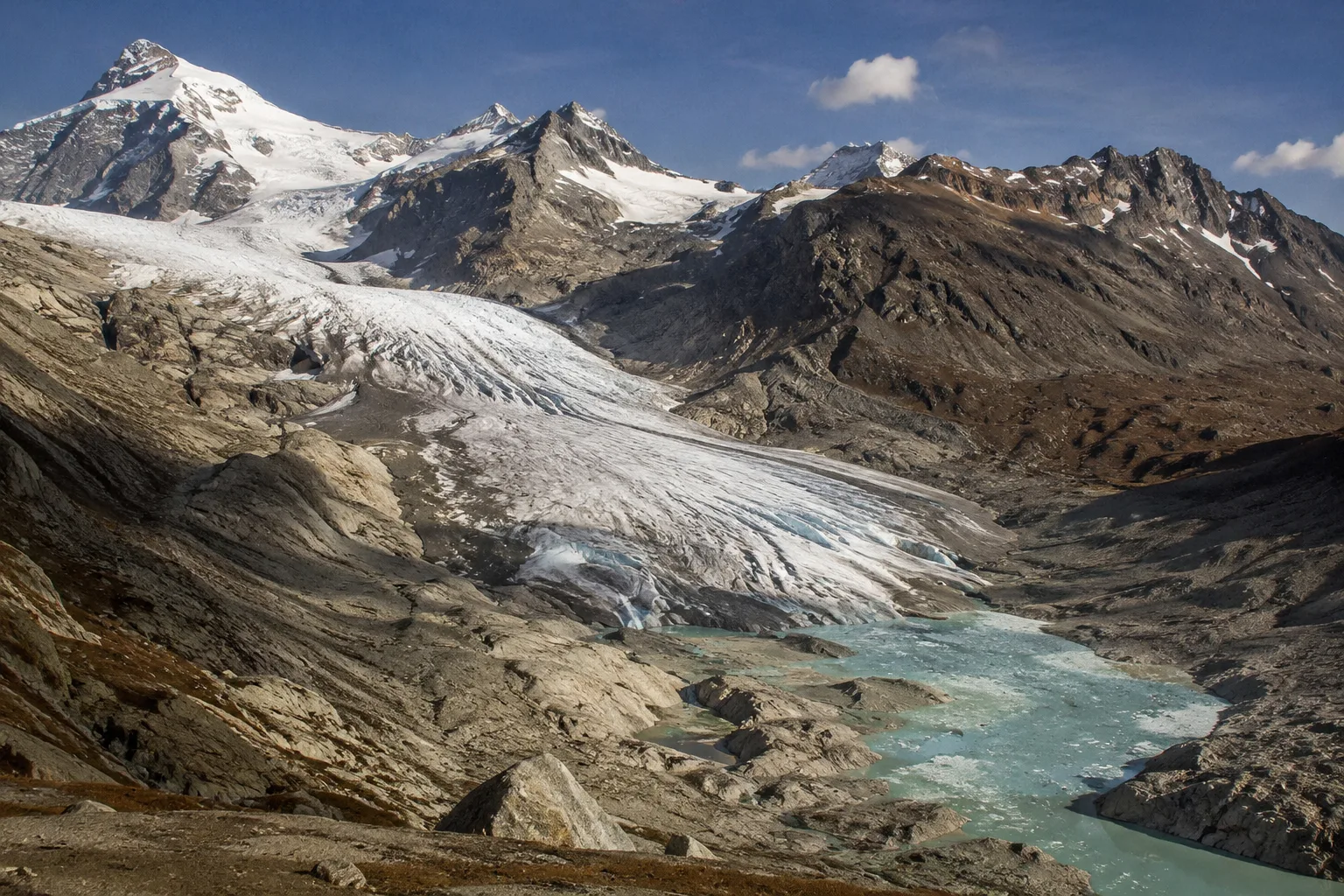
Glacier retreat exposes rock that was covered by ice for centuries. At the same time, permanently frozen ground, known as permafrost, is thawing. This mixture of rock, soil and ice acts as a natural binding agent in the high Alps. As it warms and weakens, the risk of erosion, landslides and rockfalls increases.
The consequences extend beyond hiking trails. Cable-car stations, mountain huts, roads and protective structures can find themselves standing on ground whose physical properties are changing. As a stark warning, the Swiss Commission for Cryosphere Observation points to the rock-and-ice avalanche that buried the village of Blatten in the Lötschental valley in 2025. The cryosphere is the part of the Earth where water is in a frozen state.
The freezing level is rising above the peaks
In the mountains, a few degrees determine whether precipitation falls as snow or rain. During the August 2025 heatwave, the zero-degree isotherm, meaning the altitude where air temperature reaches 0 °C, occasionally rose above 5,000 metres. Because Dufourspitze, Switzerland's highest peak, is 4,634 metres high, almost every Swiss summit was then in a zone of above-freezing air temperatures.
How much ice can remain by 2100?
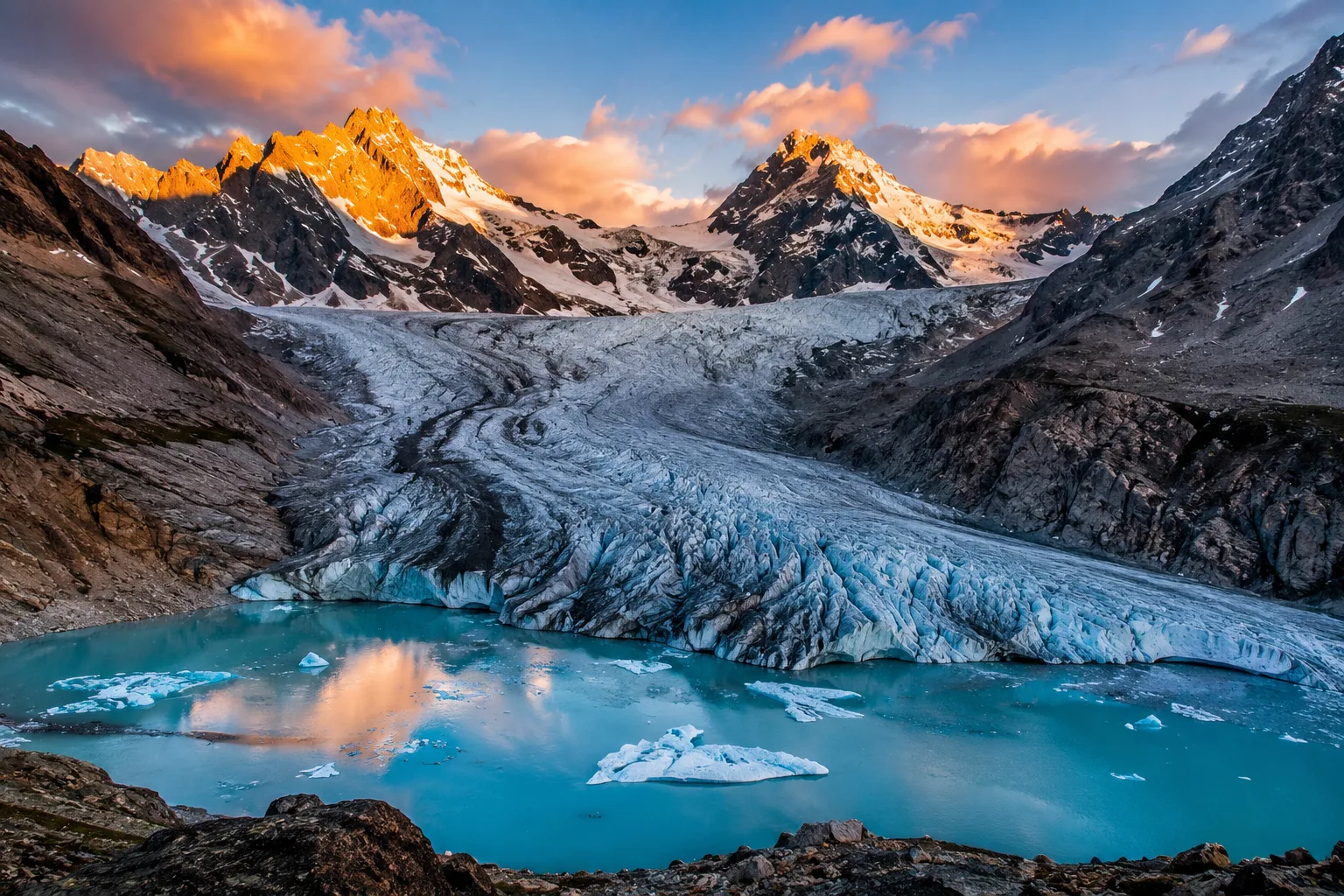
Science is no longer asking whether Swiss glaciers will retreat, but how much will survive. The NCCS scenarios show a major difference: with strong climate-change mitigation, about 37 per cent of the 2017 ice volume could remain by the end of the century. Without effective limits on warming, only about five per cent would be left.
Some loss can no longer be avoided, but its final scale is not predetermined. The difference between five and 37 per cent means a difference in water availability, infrastructure-protection costs, tourism and the appearance of entire valleys.
Switzerland is redrawing its own landscape
Places once covered by ice now contain bare rock, unstable slopes and new lakes. Hiking routes and access to mountain huts are changing, while the familiar visual language of the Alps is slowly becoming a historical record.
Switzerland will not lose the Alps, but they will look and function differently. Glacier loss is therefore not only a climate or landscape issue. It is a gradual transformation of water, safety, the economy and the identity of a country.
This article is part of the GlobalTalent24 team's research into the changes shaping life, work and mobility in Europe. If you are considering a career in Switzerland, Germany, Austria or Spain, register for free with GlobalTalent24.
Sources and further reading
GLAMOS: Annual mass balance of Swiss glaciers in 2024/25 · ETH Zurich: Winter snow reserves exhausted on 29 June 2026 · SWI Swissinfo: 20 to 30 glaciers could disappear during 2026 · Swiss Academy of Sciences: 2025 balance and freezing level above 5,000 metres · National Centre for Climate Services: Snow, glaciers, water and scenarios to 2100